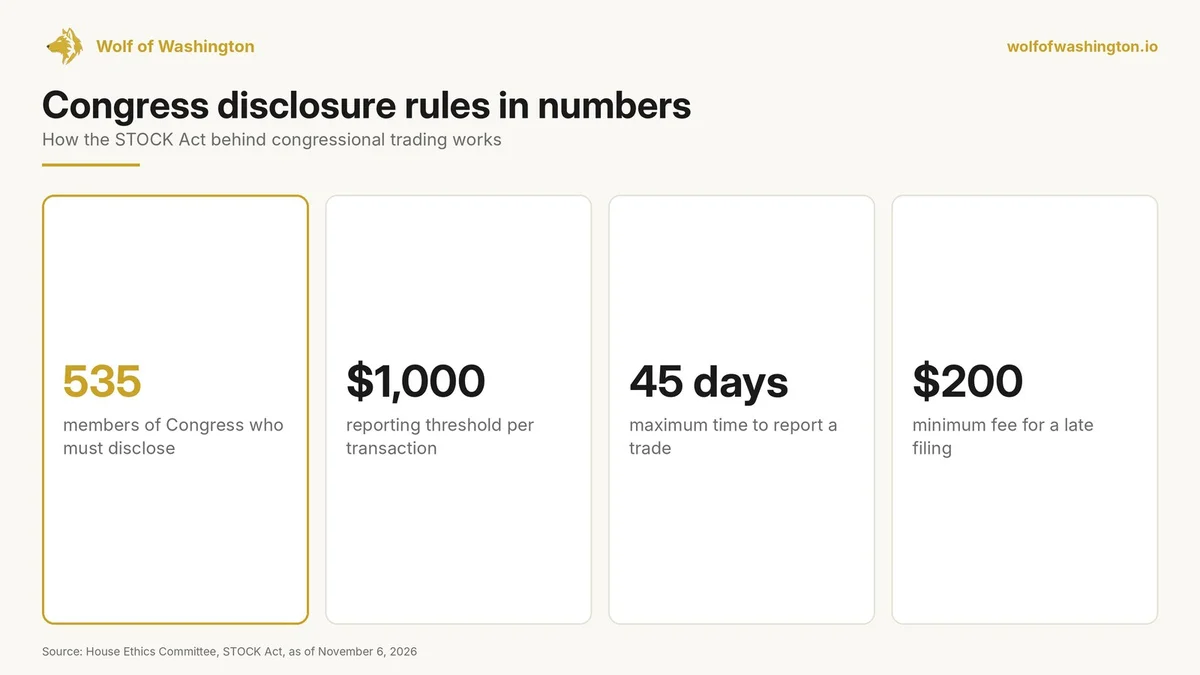
Congress stock trading is the practice of monitoring the publicly disclosed stock transactions of U.S. lawmakers — all 535 members of the House and Senate — to identify potential investment signals based on the trades of officials who have privileged access to information about upcoming legislation, government contracts, and regulatory changes. Under the STOCK Act of 2012, every congressional trade above $1,000 must be publicly reported within 45 days, making this data legally accessible to any investor worldwide.
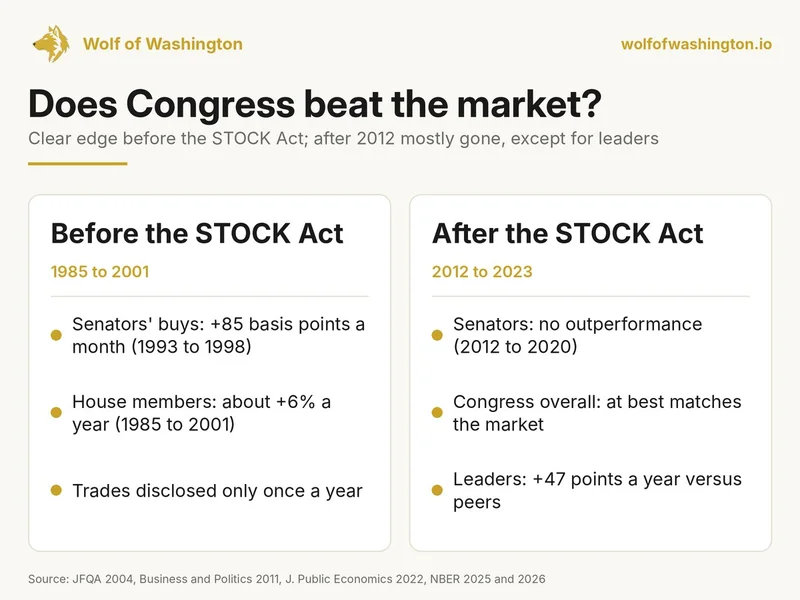
Older academic research found that U.S. senators beat the market by a wide margin in the 1990s; studies of the years after the STOCK Act are more mixed, with the strongest results for members in leadership roles. This article explains how congress stock trading works, what the STOCK Act requires, and how you can legally use this public data in your own investment strategy through platforms like Wolf of Washington.
What Is the STOCK Act and How Does It Work?
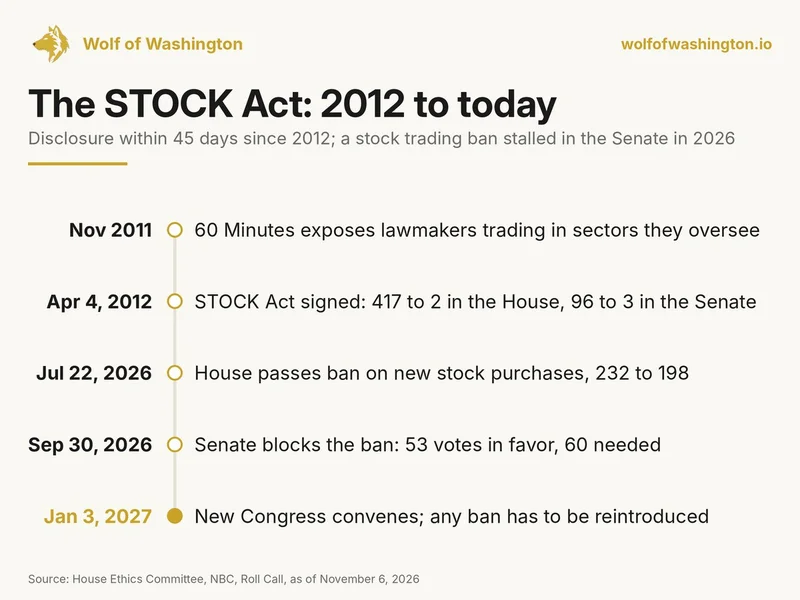
The STOCK Act (Stop Trading on Congressional Knowledge Act) is the federal law signed by President Obama on April 4, 2012, that forms the legal foundation for congressional stock trading transparency. Before the STOCK Act, members of Congress faced no obligation to disclose their personal stock trades to the public — a situation that enabled systematic conflicts of interest for decades.
What the STOCK Act Requires
Under the STOCK Act, all members of Congress and their spouses must:
- Report every purchase or sale of securities worth more than $1,000
- File the disclosure within 45 days of the transaction date
- Publish disclosures on official government portals: disclosures-clerk.house.gov for the House and efdsearch.senate.gov for the Senate
- Disclose the transaction date, the security name, and an estimated value range
The Act passed with overwhelming bipartisan support: 417-2 in the House and 96-3 in the Senate, following a CBS 60 Minutes investigation that documented years of conflict-of-interest trading by sitting lawmakers (congress.gov).
Enforcement Gaps
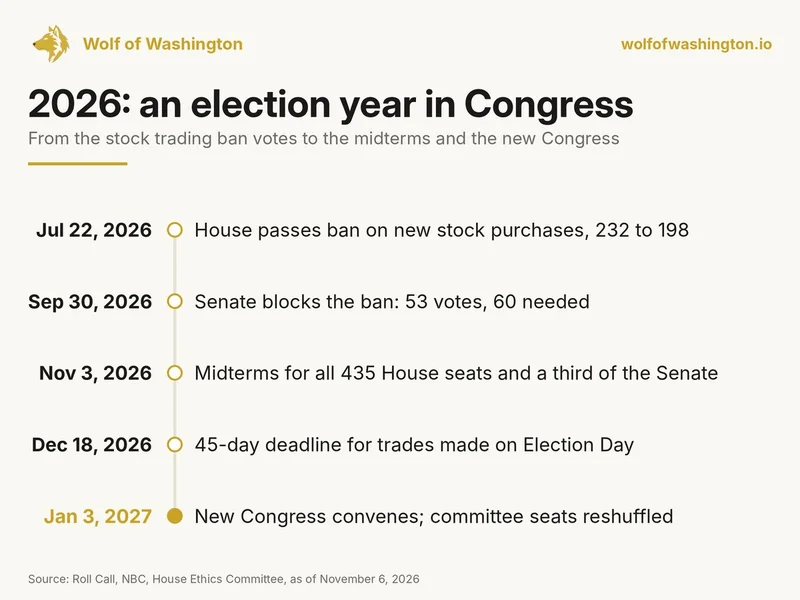
The law's primary weakness is its penalty structure: the minimum fee for a late filing is just $200. Business Insider found that 78 members of Congress violated the disclosure rules in 2021 and 2022. Bills to go further have been introduced for years; the House passed a ban on new stock purchases on July 22, 2026 (232 to 198), but it fell short in the Senate on September 30, 2026, with 53 votes in favor and 60 needed.
“After analyzing over 420,000 congressional trades, the pattern is undeniable: politicians with committee oversight over an industry consistently outperform in that sector. Wolf of Washington tracks every single disclosure so our members can act on the same signals — within 15 minutes of filing.”
The Data on Politician Stock Trades: What Research Shows
The academic literature on congressional stock trading is extensive and remarkably consistent:
See the richest members of Congress based on the official annual reports, or browse Nancy Pelosi's trades. Ro Khanna has reported 36 trades in Microsoft (MSFT) since January 1, 2025, listed under Ro Khanna's stock trades.
- Senators in the 1990s: a landmark study in the Journal of Financial and Quantitative Analysis (Ziobrowski et al., 2004) found that stocks senators bought from 1993 to 1998 beat the market by 85 basis points per month, about 10% per year. A study of 2012 to 2020 found no such outperformance (Journal of Public Economics, 2022).
- +6% for House members: A follow-up study (2011) by the same researchers found House members also consistently outperformed the market by approximately 6% annually
- 3,000+ unique securities traded annually: Congressional members collectively trade more than 3,000 unique securities per year, with a combined transaction volume in the hundreds of millions of dollars
- Technology, defense, and pharma dominate: These three sectors account for the majority of congressional stock activity — the same sectors where members exercise the most direct legislative influence
- Disclosure speed: across Congress, half of all trades are reported within 27 days, well inside the 45-day legal limit
How to Use a Congressional Stock Tracker
The tracking process: from disclosure to signal
- Trade executed — a lawmaker buys or sells stock through a personal brokerage account
- Disclosure window — the STOCK Act allows up to 45 days before the trade must be reported
- Government publication: the trade appears on disclosures-clerk.house.gov or efdsearch.senate.gov, publicly accessible to anyone
- Aggregation and analysis — platforms like Wolf of Washington automatically collect, categorize, and contextualize the disclosures
- Alert delivery — subscribers receive timely notifications on high-conviction trades with sector context and legislative background
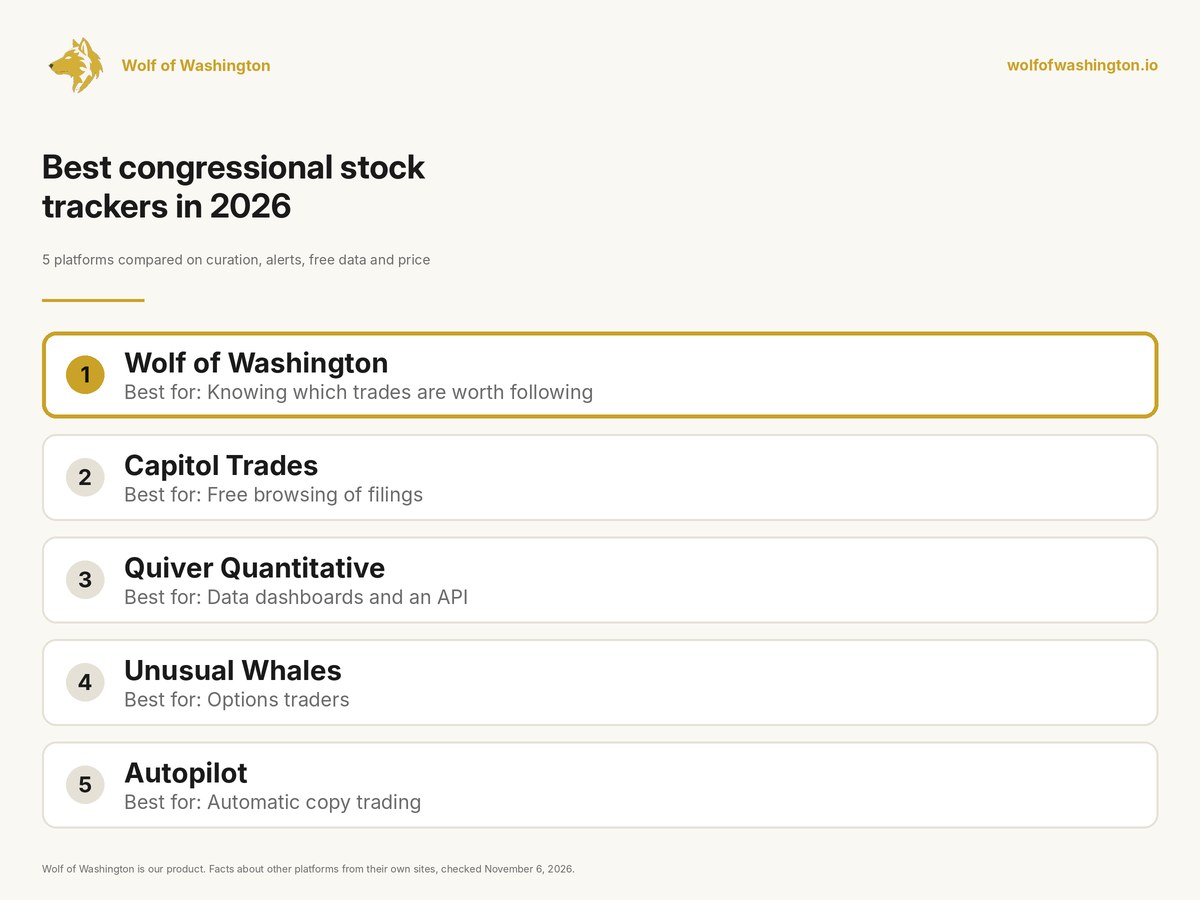
Comparing Congressional Stock Trackers
Comparing tools? Here are the best congressional stock trading trackers in 2026.
Is Congress Stock Trading Legal to Follow?
Yes — tracking and acting on publicly disclosed congressional trades is entirely legal for investors worldwide. Congressional disclosures are legally mandated public government documents, freely accessible to any citizen or investor through official government websites. This is a fundamentally different category of information from insider trading.
Insider trading involves the use of material, non-public information obtained through confidential channels. Congressional STOCK Act disclosures are the exact opposite: publicly mandated, freely available, and specifically designed to be transparent. The SEC has not imposed any restrictions on the use of this public information for investment purposes (SEC.gov, Insider Trading).
Congressional Trading ETFs: NANC and KRUZ
Investors who want passive exposure to congressional trading patterns can use two ETFs launched in 2023:
- NANC ETF: follows trades by Democratic members of Congress. Listed on Cboe BZX, expense ratio 0.72%, about $283 million in assets (October 30, 2026).
- GOP ETF (ticker KRUZ until March 2025): follows trades by Republican lawmakers. Also listed on Cboe BZX, expense ratio 0.73%, about $91 million in assets (October 30, 2026).
Both ETFs provide broad exposure but operate with inherent delays and apply no filtering for conviction level, timing quality, or sector relevance.
The Future of Congress Stock Trading Rules
Congressional stock trading has attracted intense public and legislative scrutiny. In 2022 and 2023, multiple bills were introduced to ban lawmakers from owning individual stocks — including the ETHICS Act and the Ban Congressional Stock Trading Act. As of April 2026, none have passed. As long as the STOCK Act remains in force, the public disclosure requirement continues and the data remains legally available to all investors (congress.gov).
Start Following Congress Trades Today
Congressional stock trading represents one of the few legal, data-driven investment edges available to retail investors. The data is public, the research is compelling, and the tools to act on it are available right now.