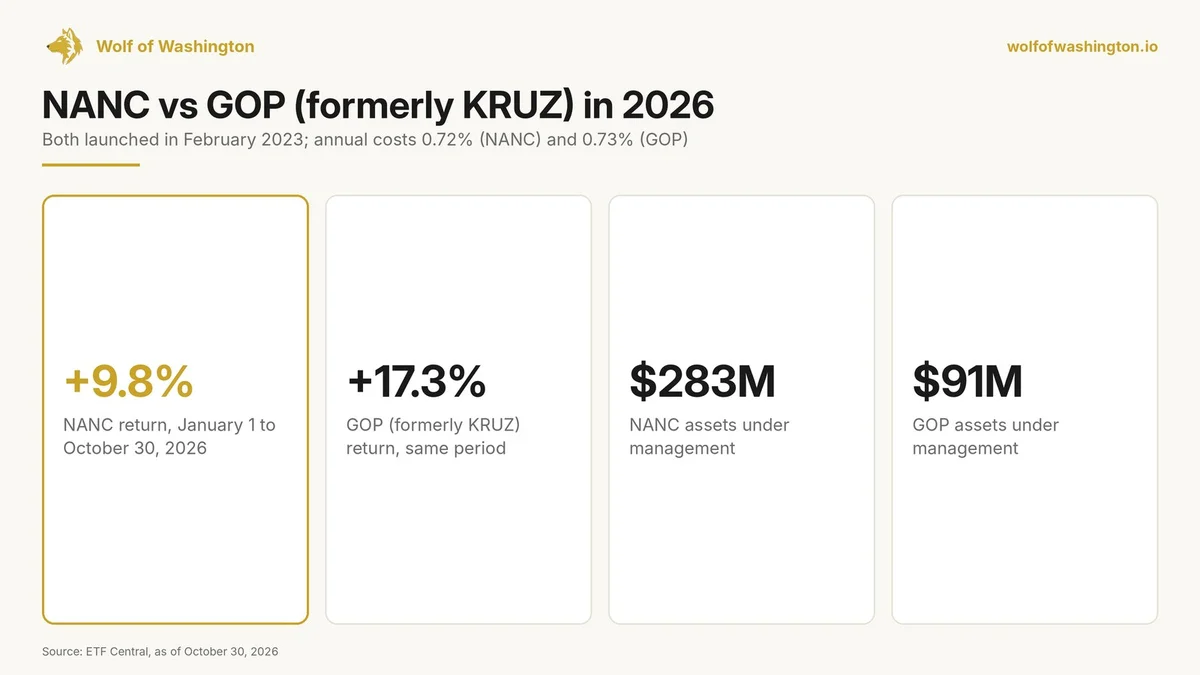
The NANC ETF and KRUZ ETF are two exchange-traded funds that track the publicly disclosed stock trades of Democratic and Republican members of the U.S. Congress respectively. Both launched on February 7, 2023 and are listed on Cboe BZX. KRUZ changed its ticker to GOP in March 2025; it is the same fund.
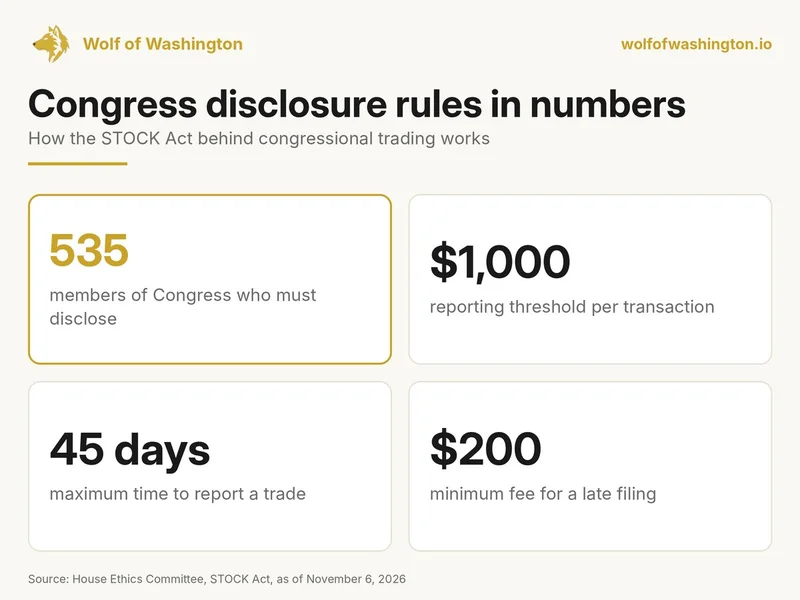
NANC (Subversive Unusual Whales Democratic Trading ETF) follows Democratic lawmakers' trades. KRUZ (Unusual Whales Republican Trading ETF) follows Republicans'. Both use the same STOCK Act disclosure data that platforms like Wolf of Washington analyze — but packaged as passive ETFs. Which has performed better in 2026, and which is the right choice for investors? This analysis breaks it down.
NANC vs KRUZ: Side-by-Side Comparison
| Feature | NANC ETF | KRUZ ETF |
|---|---|---|
| Full name | Subversive Unusual Whales Democratic Trading ETF | Unusual Whales Republican Trading ETF |
| Ticker | NANC | KRUZ |
| Exchange | NYSE Arca | NYSE Arca |
| Launched | February 2023 | February 2023 |
| Tracks | Democratic Congress member trades | Republican Congress member trades |
| Rebalancing | Quarterly | Quarterly |
| Top holdings bias (2026) | Tech-heavy (Nvidia, Microsoft, Apple) | Energy and defense-heavy |
| Dividend yield | ~0.5-1% | ~1.5-2.5% |
| Available to NL investors? | Via IBKR / Saxo (not EU UCITS) | Via IBKR / Saxo (not EU UCITS) |
2026 Performance: The Context Matters
To understand 2026 performance, you need to understand the macro context: the year began with Iran escalation, surging energy prices, record defense spending, and AI-driven tech demand. This created a strongly bifurcated sector environment:
- Energy and defense outperformed significantly — sectors more heavily represented in Republican congressional portfolios (KRUZ)
- AI and tech remained strong — sectors more heavily represented in Democratic congressional portfolios (NANC), particularly Nvidia and Microsoft
- Consumer discretionary and retail lagged — inflation-driven weakness that hurt both ETFs modestly
In the Iran-escalation period (Q1 2026), KRUZ's energy and defense tilt gave it a performance edge. Post-ceasefire and into the Wall Street rally, NANC's tech exposure caught up significantly. The net result: both ETFs are competitive in 2026, with KRUZ modestly ahead on a year-to-date basis driven by Q1 energy strength (Reuters Markets, April 2026).
Top Holdings Breakdown (April 2026)
NANC — Democratic Trades (Tech-heavy)
- Nvidia (NVDA) — ~8-12% weight (Nancy Pelosi and other Dem members' significant AI/tech positions)
- Microsoft (MSFT) — ~6-8%
- Apple (AAPL) — ~5-7%
- Alphabet (GOOGL) — ~4-6%
- Amazon (AMZN) — ~4-5%
- Visa / Mastercard — smaller positions
KRUZ — Republican Trades (Energy/Defense-heavy)
- ExxonMobil (XOM) — ~6-9% weight
- Lockheed Martin (LMT) — ~5-7%
- Chevron (CVX) — ~5-7%
- RTX (formerly Raytheon) — ~4-6%
- Nvidia (NVDA) — also held, but lower weight than NANC
- JPMorgan Chase (JPM) — ~4-5%
The Fundamental Limitations of Both ETFs
While NANC and KRUZ offer a convenient way to gain congressional trading exposure, they have significant structural limitations compared to actively tracking congressional data:
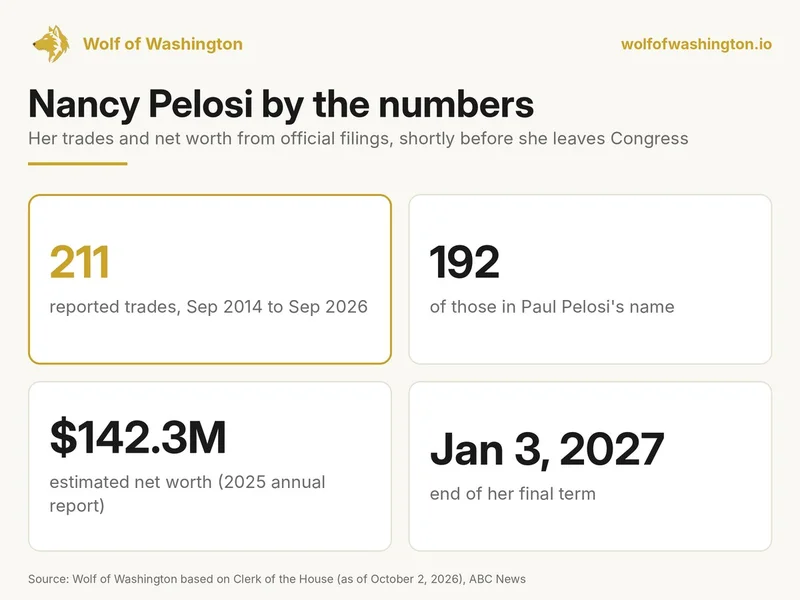
The public filings are available on our pages for Nancy Pelosi's portfolio and Ted Cruz's portfolio. Cleo Fields has reported 50 trades in Nvidia (NVDA) since January 1, 2025, listed under Cleo Fields' stock trades.
- Quarterly rebalancing creates lag: The ETFs rebalance only quarterly, meaning new congressional trades take up to 3 months to affect the ETF's holdings
- No committee filtering: Both ETFs treat a defense committee member's defense stock purchase equally with a random member's unrelated trade — losing the highest-value signal
- Fees add up: NANC charges 0.72% a year and GOP 0.73%. Over 20 years, this cost compounds significantly.
- Party-based logic is imperfect: The most informative signal is committee membership, not party affiliation. The best trades come from bipartisan committee members, not party-line investors
- Not UCITS-compliant: EU/NL investors face regulatory barriers — not available on most European brokers without specialist access via IBKR or Saxo
NANC vs KRUZ vs Wolf of Washington: The Real Comparison
| Approach | Signal Quality | Timeliness | Cost | EU Access |
|---|---|---|---|---|
| NANC ETF | Medium — no committee filter | Quarterly lag | – | ❌ Difficult |
| KRUZ ETF | Medium — no committee filter | Quarterly lag | – | ❌ Difficult |
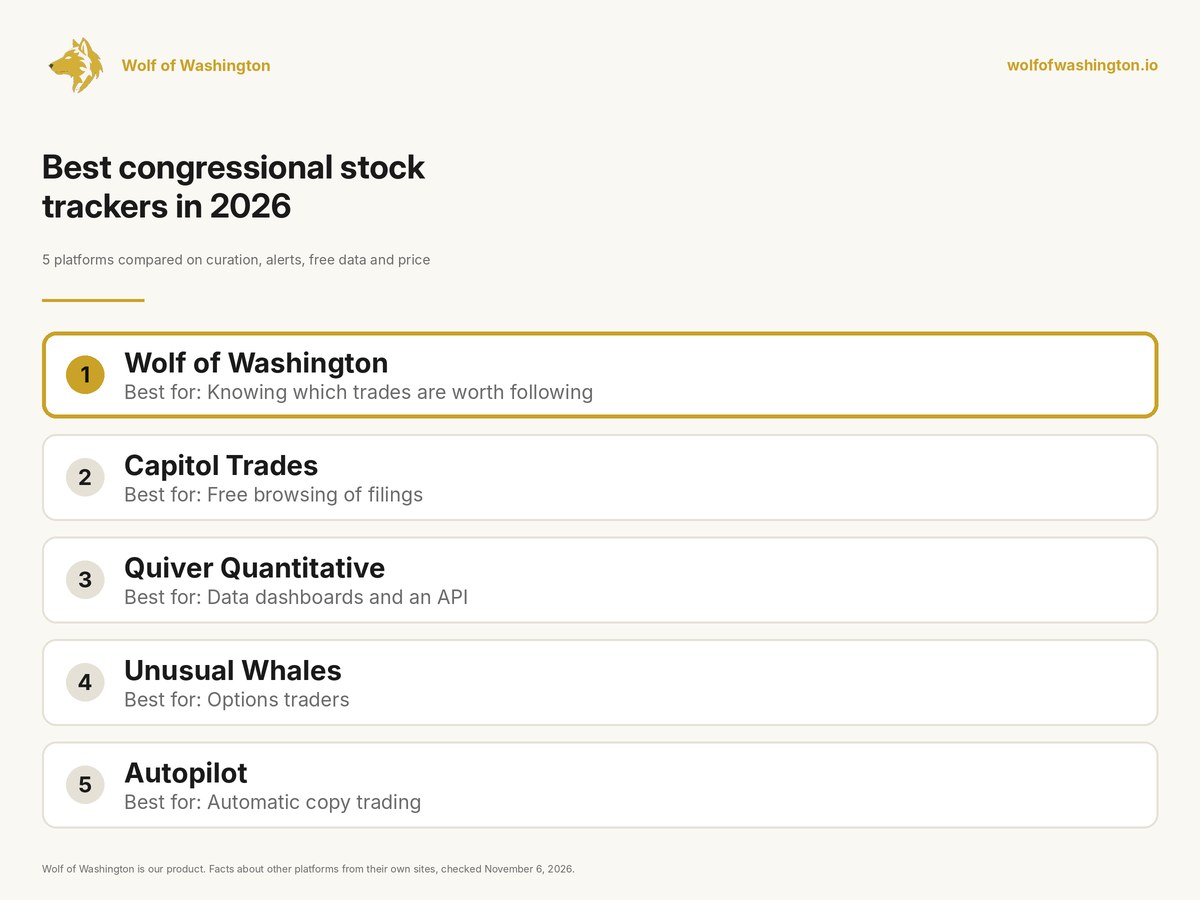
| Capitol Trades (free) | Low — raw data, no analysis | 24-48h lag | Free (basic) | ✅ Web-based |
| Wolf of Washington | High — committee-filtered, sector-analyzed | – | – | ✅ Full access |
Which Should You Choose: NANC or KRUZ?
For investors who want passive congressional trading exposure and have access (via IBKR or Saxo):
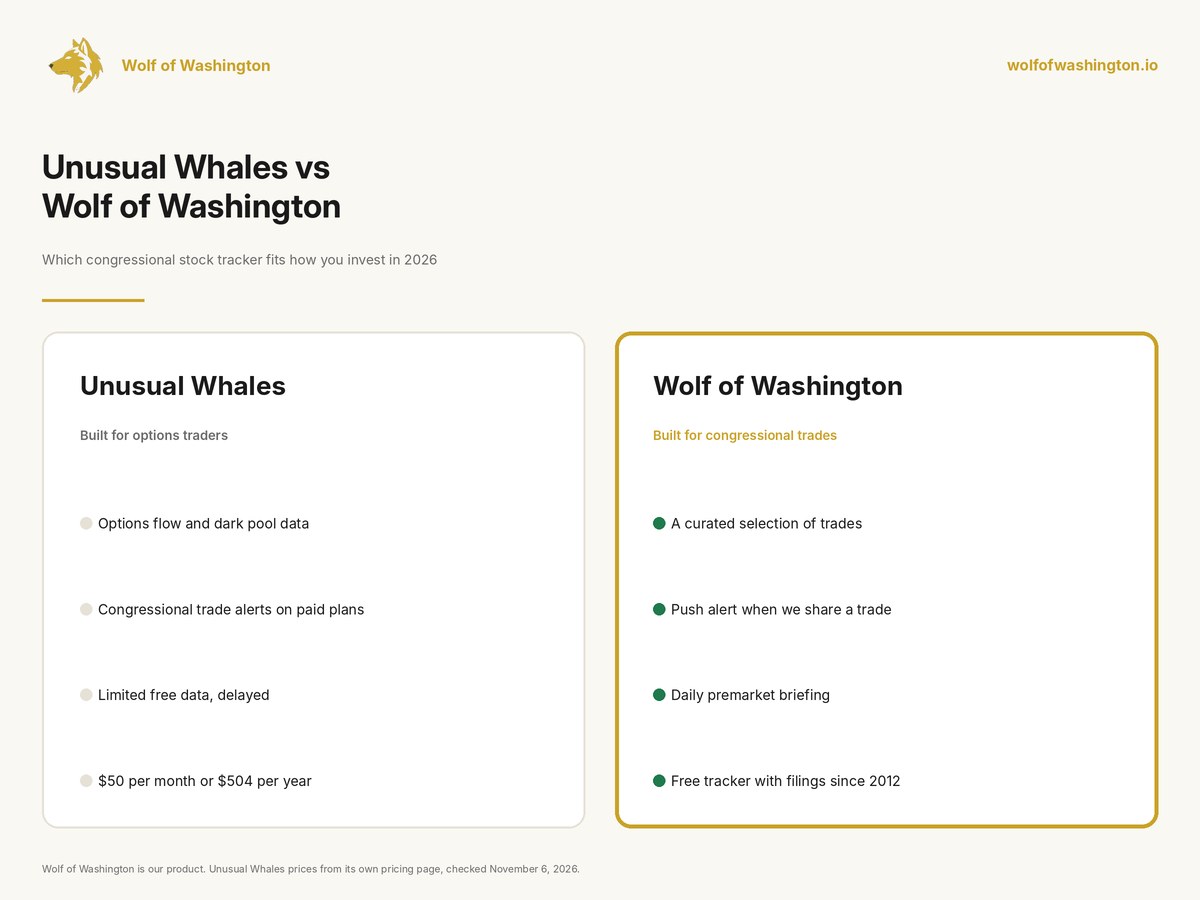
Wolf of Washington tracks the same politician stock trades directly from the official filings.
- Choose NANC if: You believe AI/tech will continue to outperform and you want a Democratic-leaning tech-heavy portfolio
- Choose KRUZ if: You expect continued energy and defense strength driven by geopolitical tension and NATO spending
- Consider both together: A 50/50 allocation gives broad congressional trading coverage across both parties
Get Smarter Congressional Trading Data
The highest-value signals come from knowing which committee member bought what sector — weeks before the ETF rebalances to reflect it.